Home » 2014 (Page 2)
Yearly Archives: 2014
When Reality Isn’t Good Enough: Addressing Real Race Issues
By Nicole McGowan
I became conscious that I was Black when I was 5 years old.
Surrounded by pink bodies, I was ashamed of my brown skin. All the dolls in school were White along with the children in our textbooks—laughing, happy, smiling faces that didn’t look like me.
This is how I begin my personal statement, which explores my identity, self-worth, passion for education and ultimately my future contributions to society. It’s safe to say I’ve been thinking about race for a very long time.
Today I received an email from a professor sharing an article on Huff Post that again forced me to take a critical stance on race and its implications for achievement within the United States. The Difference We Haven’t Overcome: Why the Color Line Endures in America introduced me to the perspective of viewing race as the “different difference”. Robert T. Carter points out “Other historically oppressed groups in the United States have seen dramatic improvement in their circumstances”. In an attempt to not undermine his argument, I strongly suggest reading the entire article.
What I would like to point out is his attention on the inferior status of the services provided to people who are oppressed due their skin color and how these services are not improving. The reality is that people of color in the United States suffer and the injustices aren’t making marked improvements. The hands of institutionalized racism are killing black men and women. And as Carter points out these aren’t “isolated events”.
As an educator, it’s difficult to comprehend what this means for my Black and Brown babies I encounter in the classroom. How can I trust this world to support, uplift and foster my kindergarteners’ education when I can’t trust that they are being treated fairly based on their character rather than their color? I don’t worry about myself. I worry about my babies. I am overwhelmed with a sense of guilt— wishing I could protect them from the evils and dangers that attack and vilify children of color.
My wishing and hoping won’t change the fact that race plays a very important role in shaping the lives of my young learners. Until we can get everyone on board with this understanding and proactively working to change this heinous reality, I will continue to be plagued with fear.
New year, new possibilities
The third year of our YMEJ seminar has begun! This year, we are focusing more explicitly on multiliteracies (the “M” in YMEJ), while still engaged in ample media production and media analysis in our journey to explore the ways in which the stories, lives, and institutional experiences of court-involved young people are represented and mediated.
Once again, we have an exciting new group of graduate students from several different departments at Teachers College who are taking this journey with us. You will be hearing from them soon.
Last week we were visited by the inimitable Prof. Suzanne Carothers who reminded us that we must look inward before we can move forward with our desires to “help” — in her invitation are echoes of those wise words from Australian Aboriginal artist and elder, Lilla Watson: “If you have come to help me, you are wasting your time. But if you have come because your liberation is bound up with mine, then let us work together.”
As in years past, we are fortunate to have built a strong circle of critical friends who join us as guest speakers and share their insights and pose invitations to us to look and look again differently at that which we are in the pursuit of trying to understand. In this seminar, all of us are always students and teachers; we all learn with and from each other and of course with and from the young people with whom we continue to work and in service of whose educational wellbeing we are committed.
Join us as we embark on this next leg of our journey and as new bloggers share their perspectives with you. And in the meantime, don’t forget to follow us on twitter: @YMediaJustice
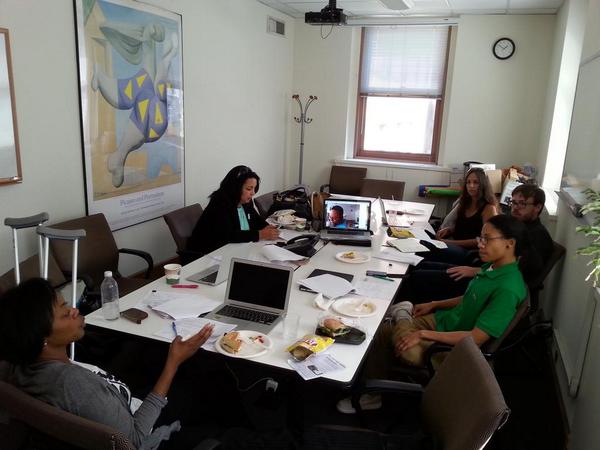
Planning for this year’s YMEJ Seminar
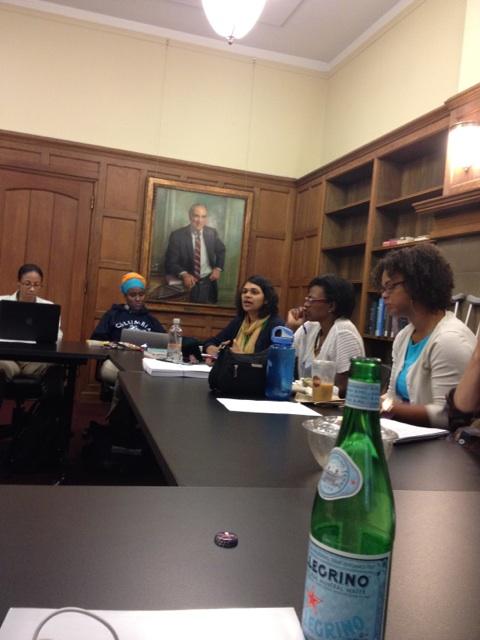
First class (photo by Melissa Wade – @honeybee22274)
Who are you?
“Who are you?
Please, tell me anything you would like to.”
This narrative is the story of an encounter. It is her narrative, it is mine, it is ours, it is the present. How could we represent it?
“Narrative is radical, creating us at the very moment it is being created.” (Morrison, 1993)
How do I connect with someone at a first encounter? What is the meaning of our experiences? How could the narrative be voiced without being manipulated by the producer?
“Perceiving something from two different angles creates a split in awareness” (Anzaldua, 2003, p.549).
The process of making this video was the whole purpose. The final production simply engages the audience to listen, listen, and listen again.
What narrative(s) are you hearing? Are you certain? At which moment, do you connect with the voice? What does listening means? What does understanding means? How do multimodal artistic pieces impact your life? How do you build from it?
If a space for possibilities is created, youth will take the opportunity.
“We have the power because we are together in speech and action, and because possibility spreads before us, and because there are boundaries to break through.” (Maxine Greene, 1982, p.9)
Now, plug your headphone, click on the link, and listen.
References
Anzaldua, G.A. (2003). now let us shift. This bridge we call home. (p. 540-579).
Greene, M. (1982). Public Education and the Public space. In Educational Researcher.
Morisson, T. (1993). The Nobel Prize in Literature 1993. Retrieved from: http://www.nobelprize.org/nobel_prizes/literature/laureates/1993/morrison-lecture.html
Emerging questions via mentoring
Here are some questions that emerged for me after mentoring at Voices, an alternative to detention program, for eight months, through the YMEJ graduate seminar:
- What does it mean to build a relationship not just with a person, but a group of people, and perhaps even a program?
- How does this create/foster a multi-directional mentoring relationship?
- What are the commitments that people make to each other, to themselves and perhaps to an ideal?
- How does spending time analyzing and understanding these commitments allow me to develop a stance that is not only for my research but for my entire life?
This experience made me realize how much I want to privilege working with young people in my future research and in my life.
- How do I maintain my role at Voices now that the seminar is ending—is it possible?
- How do I recognize, understand and navigate large systems in which many of the people I care about are intertwined?
- How do I keep this present in my writing and research in an authentic way?
- How do I help to create sustainable mentoring opportunities?
- How do I expand conceptualizations of mentoring?
More questions than answers, I hope to return to this post and annotate it as my thinking continues.
Being there
Being there is a term that came up a lot in our conversations in the YMEJ graduate seminar this year. In discussing ways to re-imagine experiences for court involved youth, our conversations often circled back to the support networks people require in order to live. Michel Bérubé (1996) makes a similar point in his book, Life as we Know It about his family and his son Jamie who has down syndrome. In his discussion of Jamie’s growth and development Bérubé notes that people with labeled disabilities are not the only ones who require a strong support network in order to survive and thrive. In fact, everyone benefits from such a network.
Our conversations in YMEJ centered on how to “be there” for a court involved young person, and for each other. We discussed the importance for all people (and especially young people) of having at least one person in your life who is going to stand by you no matter what. Beam (2013) has a similar theme when she quotes a participant’s phrase: “You gotta rock with a kid all the way”.
For me, the phrase “Being there” brings up memories of a movie with the same title starring Peter Sellars (the last movie released while he was alive). The film is a comedy, but also poignant in conceptualizing the phrase being there. The main arch of the film is that Chance (Sellar’s character), a gardener for a large estate has always been there. For all intents he is a non-entity, yet when people meet him, they mistake him for the owner of the estate and begin projecting their own thoughts and ideas about him. My point in bringing up the film (beyond the fact that it is fantastic and I highly recommend watching it) is that being there is itself a passive sentiment. I do not mean this as a critique, but to point out the multitude of ways to support another person without infusing your own thoughts, ideas, actions etc. As the movie highlights, being there is a passive, yet powerful act.
It is especially powerful when you consider the complications that inundate the various systems for court-involved youth. Being there for someone, rocking with them all the way, sounds somewhat simplistic. Of course, people engaging in this work will tell you it is far from simple. In truth, sometimes being there is not enough. But it is a place to start and something I believe, all people can decide to do. I think it helps when you collaborate, if you are going to be there for a young person, you need to have someone who is there for you.
In the YMEJ seminar we created a community that is by no means perfect, but I do think it is comprised of people who are willing to be there for each other. Being there for each other and by extension the people in our lives, we begin to weave a powerful network. It helps me sustain through the difficulties of this work. It helps me imagine the possibilities for making small shifts in the larger systems. This work cannot be done alone. Being there for each other is an integral first step.
Becoming through our [future] work
The YMEJ graduate year-long seminar ended this week with an exhibition in Russell Library. Each member of our course conducted a year-long inquiry through participation in the course and a mentoring experience. Lalitha, one of the members of the teaching team, wrote a note to us on the course blog entitled, Becoming… which focused on our continued growth and development during the course and beyond. In the text, Arts, Media and Justice co-edited by Lalitha Vasudevan and Tiffany DeJaynes, Vasudevan quotes Maxine Greene “I am what I am not yet”. Though I am at the end of my experience in the YMEJ course, I do not see the work as finished and I look forward to building upon my experience as I continue my doctoral career. Since I began my course work at TC I have begun to look more deeply and pay more attention, one area that YMEJ helped me hone was my attention to media and the different types of media that are produced, specifically around issues of court involved youth.
In my own work, I am sinking myself into disability studies in education and the possibilities this stance provides for thinking about teaching and learning for all young people. Therefore, when I saw the recent print advertisement for New Alternatives for Children (NAC), I felt it was a perfect connection between the YMEJ course and my own interest in disability studies. New Alternatives for Children is a “child welfare agency child welfare agency exclusively devoted to serving children with severe disabilities and chronic illnesses” (http://www.digitaljournal.com/pr/1854796).
The recent ad campaign (both print and televised) is produced by Grey New York and is titled, “Rethinking Foster Care” and geared at educating (or perhaps re-educating) New Yorkers about foster care in the city and especially for those young people with labeled disabilities. First, how do we as recent participants in YMEJ seminar ourselves involved (and for many committed to) in re-thinking or re-imagining space for court involved youth analyze a video spot, such as the one for NAC? Their campaign is called, “Rethinking Foster Care” but based on the video, I do not think they are rethinking the experience of foster care for young people with labeled disabilities. Instead, I would argue they are perpetuating deficit-based conceptualizations of the young people the organization aims to serve. This is a difficulty and beauty of interdisciplinary work. As terms or ideas stretch across different ideologies and philosophies, it is up to the people using them to make an attempt at conversation, collaboration and shared understanding. Difficult work and that is also messy.
My first viewing of the television spot brought me back to something Cris Beam (2013) writes about in To the End of June when she discusses the different reasons people adopt children. One reason Beam discusses is altruism. Mary, a participant in her book states, “People should do it because the kids need. Otherwise, they are going to be disappointed” (p. 94). I think advertisements like the one for NAC complicates this statement because of the way people with labeled disabilities are positioned throughout history. Often seen as the neediest of the needy, in fact, sometimes this is referred to as narcissism (Siebers, 2008) and becomes an albatross for a person with a labeled disability who requires help and support. But not due to vanity or self-love, as it is sometimes positioned in society. And it is true, kids do need and the NAC commercial makes this clear. It also has an underlying savior mission.
Since the disability rights movements in the 1960’s and 70’s and the development of the scholarly field of disability studies people have been analyzing and theorizing about the disability itself. Many disability studies scholars view disability as a socially constructed and note that the environment in which a person with a disability lives is disabling. This takes the concept of disability outside of the person, moving away from a medical model that maintains disability as a problem within a person that should/could be fixed. While the NAC commercial does not position youth in foster care with disabilities as needing to be fixed, they do use the term special several times. Making the claim that a special child needs a special parent. Furthermore, the article states that many young people with disabilities live in hospitals or other long term care facilities because their parents are unable to care for them http://www.digitaljournal.com/pr/1854796).
I wonder (as Beam discusses in her book) what types of supports and structures should be offered to birth families to support care for all children? Also, what do we learn from the distinction made between types of children and how they are positioned through foster care/adoption? How does this support thinking about our own definition of re-thinking or re-imagining? Finally, as we (the YMEJ graduate seminar students) are becoming how do we continue to use this class to inform our future teaching, research, and ways of being in the world?
Here is a link to the television spot: http://vimeo.com/92176294
More information of New Alternatives for Children: https://www.nackidscan.org/what_we_do/index.php
Information on the advertising agency: http://grey.com/us
2nd Annual YMEJ Clothing Drive
Donation bins in Zankel Hall & Whittier Hall, Teachers College
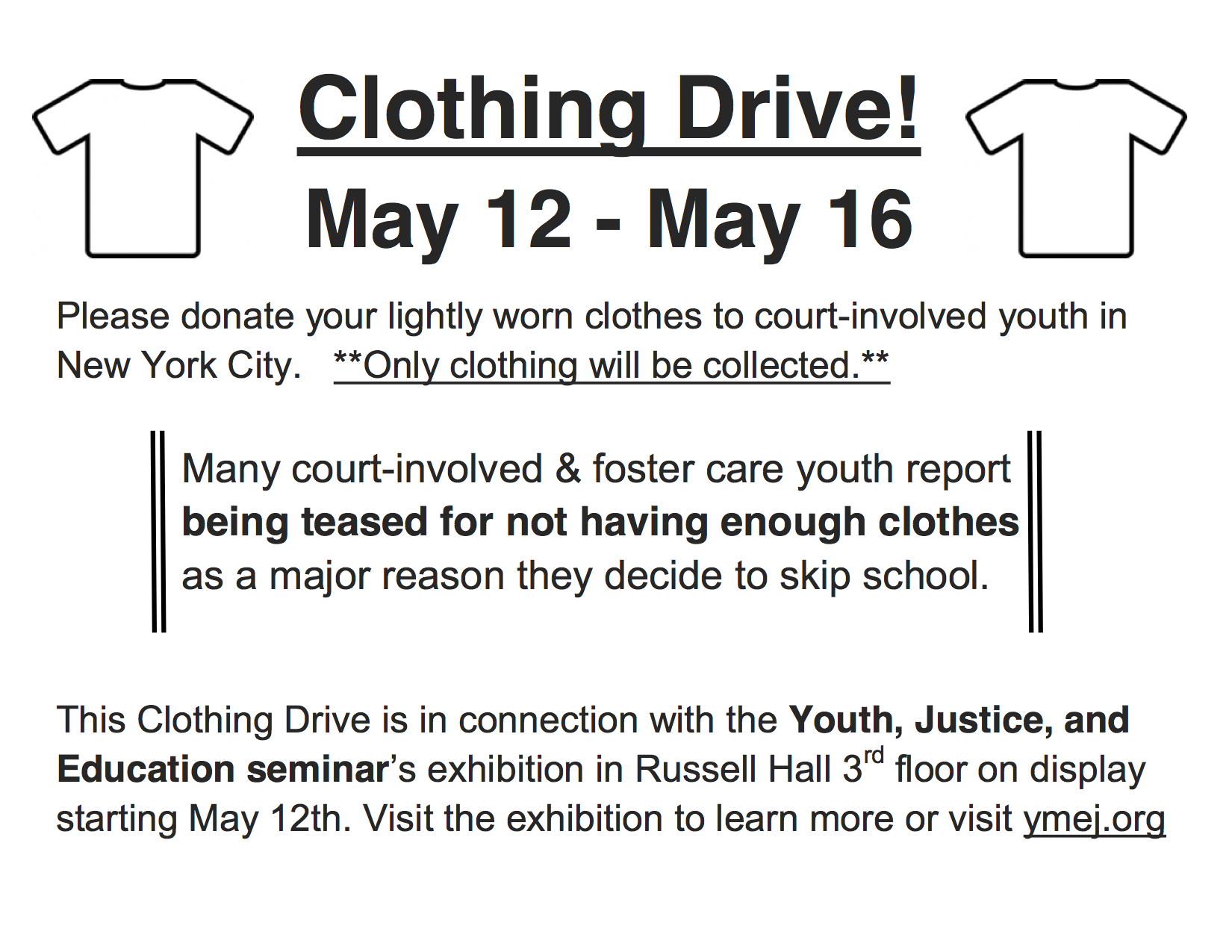
In conjunction with this year’s YMEJ Exhibition — “Inquiry into Educational Justice” — we are launching a clothing drive to collect new and like-new items of clothing that will be donated to alternative to detention (ATD) programs in New York City.
This clothing drive is our second, and follows on the huge success of last spring’s event in which we collected over 65 bags of clothing and accessories that were distributed to 5 different ATDs in three boroughs. In our work with youth, we have consistently heard from them that a major obstacle to regular school attendance is the fear of being teased or bullied for a lack of clothing. Thus, we reached out to the Teachers College and greater Columbia University community and were overwhelmed by students’ thoughtfulness and generosity. Our ATD partners were similarly touched and Ana Dopazo, a Senior Education Specialist at Choices ATD, shared these thoughts with us:
Usually when people hear of a child who is consistently missing school they think that the child is getting into trouble or not interested in school or lazy etc…but in actuality there are many reasons that a child might not be succeeding academically that are not by choice. The participants that we usually have in our program are living in poverty. We constantly see kids that refuse to go to school because they don’t have clothes that are clean, in good condition, or that even fit properly because they’ve grown out of it or are sharing clothes with family. Sometimes just getting them new clothes is the simple solution to their school attendance…it gives them their confidence, allows them to feel comfortable in a social setting, and it gives them the motivation to go to school. Many people can’t understand why this would affect someone so tremendously because most of us don’t realize that being able to go shopping for clothes is a luxury, and not something that everyone is capable of doing. The clothing drive will help our kids in need to hopefully be able to add a few items to their wardrobe that will allow them at least some outfits they can mix and match to attend school. I don’t think that this is the answer to all our truant kids but it’s a start…it’s an opportunity to allow these kids that actually want to go to school a chance to have a normal educational experience without the worries of whether or not he/she will have something to wear to school. This clothing drive can also be the answer to our kids not getting rearrested for stealing things they need and may also prevent teasing or bullying in school. So its not just giving a kid a shirt or pants to wear its so much more that: you are contributing to this child life.
Please share this information widely and look for donation boxes in both Zankel Hall and Whittier at Teachers College — and please consider making a clothing donation.
YMEJ Exhibition: Inquiry into Educational Justice (May 12th – June 2nd)
If you’re in NYC, come and visit our exhibition, “Inquiry into Educational Justice,” featuring multimodal publications produced by this year’s cohort of YMEJ Seminar graduate students. In these publications, the YMEJ students explore a variety of issues and topics related to educational justice and draw on a variety of media and multimodal resources to bring their yearlong inquiries to life for a broader audience.
The exhibition is part of YMEJ’s commitment to public pedagogy and was made possible by the material and technical resources and support of EdLab at Teachers College, who helped us bring our aesthetic visions into reality.
Details
Where: M. W. Offit Family Gallery, 3rd Floor, Teachers College (525 W. 120th St., 10027)
When: Monday, May 12th through Monday, June 2nd
Learn more about the exhibition here; and please let us know what you think if you do visit.
Note: We are also sponsoring a clothing drive as another element of public pedagogy and social action in conjunction with this exhibit. Click to learn more.
(photos from our opening reception soon to come!)
“Because I’m 16”
New York is the only state other than North Carolina that prosecutes youth as adults when they turn 16. According to Raise the Age NY, an advocacy campaign for increasing the age of criminal responsibility:
Nearly 50,000 16- and 17-year-olds are arrested and face the possibility of prosecution as adults in criminal court each year – the vast majority for minor crimes (75.3% are misdemeanors).
Furthermore, more than 600 children ages 13 to 15 are also prosecuted in adult criminal courts –seriously diminishing their life prospects before they’ve even entered high school.
Over 70% of the children and youth arrested are black or Latino. Of those sentenced to incarceration, 80% are black and Latino.
On their own, the statistics above are disturbing, painting a bleak picture of a system that is misaligned with science around adolescent development and the experiences of so many, including policy makers, who remember being young, impulsive, and rebellious. When paired with the voices of young people and the exposure of the hypocrisy evident in laws governing youth behavior, as in a recent PSA from the New York Center for Juvenile Justice, the statistics take on an even more penetrating message.
Because I’m 16, I can’t drive at night.
Because I’m 16, I can’t get a cell phone without my parents.
Because I’m 16, I can’t get a flu shot without my mother’s consent.
At 16, I’m not allowed to watch an R-rated movie alone.
Because I’m 16, I can’t sit on a jury, but I can be tried as an adult.
Listen to these young people making the case for “Judging Children as Children.”
Does Every Action Really Lead to an Equal and Opposite Reaction?
At the Educational Justice Symposium on March 31st, 2014, Michelle Fine reminded us that people and their actions aren’t necessarily so different; however, society’s reactions vary quite a bit. Although research certainly supports this point, it seems to get lost in all the deficit-based discussions about what’s wrong with kids, families, and communities that lead to some kids winding up being court-involved. A better question might be, what’s wrong with our systems of education, law, social work, etc., that lead to Black kids getting much harsher consequences, including incarceration, than White kids for the exact same behaviors (see, e.g., Michael Rocque & Raymond Paternoster’s 2011 article in The Journal of Criminal Law and Criminolology: “Understanding the Antecedents of the ‘School-to-Jail’ Link: The Relationship Between Race and School Discipline”).
The questions we ask matter because different questions lead to different answers. If we ask, what’s wrong with these kids that cause them to wind up court-involved? then we are likely to find something “wrong” with the kids (hey, nobody’s perfect) that we might easily assume leads to court-involvement. We then try to “fix” the kids in order to reduce their court-involvement. However, the problem remains that, when kids perform the same actions, they receive pretty different reactions from society.
If, on the other hand, we ask, what’s wrong with these systems that cause them to punish Black kids so much more harshly for the same actions as White kids? then we will get pretty different answers. So far, it seems like there are problems all down the line, starting from individual teachers making decisions in their classrooms, to school-level responses, to arrest and sentencing rates. And remember, these reactions vary for the same kid actions. If, for example, a White kid and a Black kid are both found in the gym when they are supposed to be in math class, the White kid is much more likely to receive a milder punishment, such as a phone call home. The Black kid is much more likely to receive a harsher punishment, such as suspension; in fact, there have been cases of kids in this situation getting arrested for “trespassing.” Two kids, equal actions, hugely unequal reactions.
 Youth, Media, and Educational Justice