Home » 2014 (Page 3)
Yearly Archives: 2014
“Being tough on crime and tough on criminals is not the same thing…”
Just came across this article on Policy Mic featuring a short animated video about mass incarceration in the United States. Vloggers Hank and John Greene worked with visual.ly and The Prison Policy Initiative to create the video. The vlogging brothers write in the description of the video on YouTube,
It wasn’t easy to pick this topic, but I believe that America’s 40-year policy of mass incarceration is deeply unethical, not very effective, and promotes the security of the few at the expense of the many.
It’s hard for me, as a person who was born into privilege, to imagine the challenges convicted criminals face, often for crimes that are utterly non-violent.
If you’re feeling like you want to do something about this, I’m mostly just making this video as an informational resource and to encourage people to think of felons not as bad, scary people but just as people.
The people at The Prison Policy Initiative were very helpful in the creation of this video and if you want to learn more about their work and how to get involved go to http://www.prisonpolicy.org
To be sure, the video does not cover all aspects of the conversation–there is not mention or discussion of how race and class factor into the conversation (e.g. how there is an insanely disproportionate amount of young, lower or working-class Black men in the prison system), but the video is engaging, offers a number of jarring facts, and will hopefully spur some conversation, raise awareness, and prompt people to want to learn more about the injustices of the prison system in the U.S.
Leveraging Individual Talents to Make Change In the Lives of Former Foster Youth
According to San Francisco Court Appointed Special Advocates for Children, there are 65,000 children and youth in foster care in California—by far the highest population of any state. Each year over 4,000 foster youth “age out” of this system. Within the first 2 to 4 years after emancipation, 51% of these young adults are unemployed, 40% are on public assistance, 25% become homeless, and 20% will be incarcerated.
Importantly, attention is being turned to this crisis and individuals and communities are mobilizing. In a recent report on KALW Local Public Radio in San Francisco entitled “A Starting Place for Former Foster Youth,” journalist Rachel Wong highlights individuals in the San Francisco community who are experimenting with new ways to support these young people educationally, professionally, and personally. Wareene Loften, age 73, is featured in the story as a striking example of the power of leverging individual talents to make change in the lives of others.
After one year volunteering as a mentor at Guardian Scholars, a program at the City College of San Francisco that provides support for foster youth, Wareene Loften “recognized pretty quickly how much the students struggled with housing.” As a real estate agent, Loften felt that her skills and services could be put to good use. At first, Loften helped by locating open sublets for individual students in local residences. Then, in December 2012, she convinced an owner of a home near City College to let her rent the house and then sublet it to four Guardian Scholar students. In doing so, Loften was able to do what she thought was best for her students— to provide opportunities for independent living and a flexible payment schedule. “I pay the rent upfront, and they reimburse me, so I’m giving them that leisure time to get their money together,” she says.
The project has been a success with Loften’s ingenuity and outlook on foster youth being praised by tenants like Darrel Molett:
Not a lot of people believe in foster youth. They believe we mess things up more than fix things. And she took it the other way around. She said we fix things more than mess things up.
Looking forward, Loften is looking to expand her model and hopes to recruit more likeminded people to join the cause. The fate of too many young people in California and across the country is at stake. As she explains,
Somebody needs to do it. It just has to be done.
Possibilities
by Roger Horton
At the Educational Justice Symposium on March 31, one of the many memorable speakers was Kenneth Phillips from The Possibility Project. He spoke of Project’s humble beginnings as City of Peace on the streets of Washington, DC, as a way to address violence and racial division – and of its current focus on using performance art and community action to empower NYC teenagers in multiple ways.
I have been impressed with other NYC-based organizations that use performance art as a means to engage young people such as the All-Stars Project and Theatre of the Oppressed.
At the Symposium I was fascinated by Kenneth’s description of how youth who become a part of The Possibility Project’s programs (through non-competitive auditions) are often transformed while learning much about themselves, their abilities, and how they relate to others.
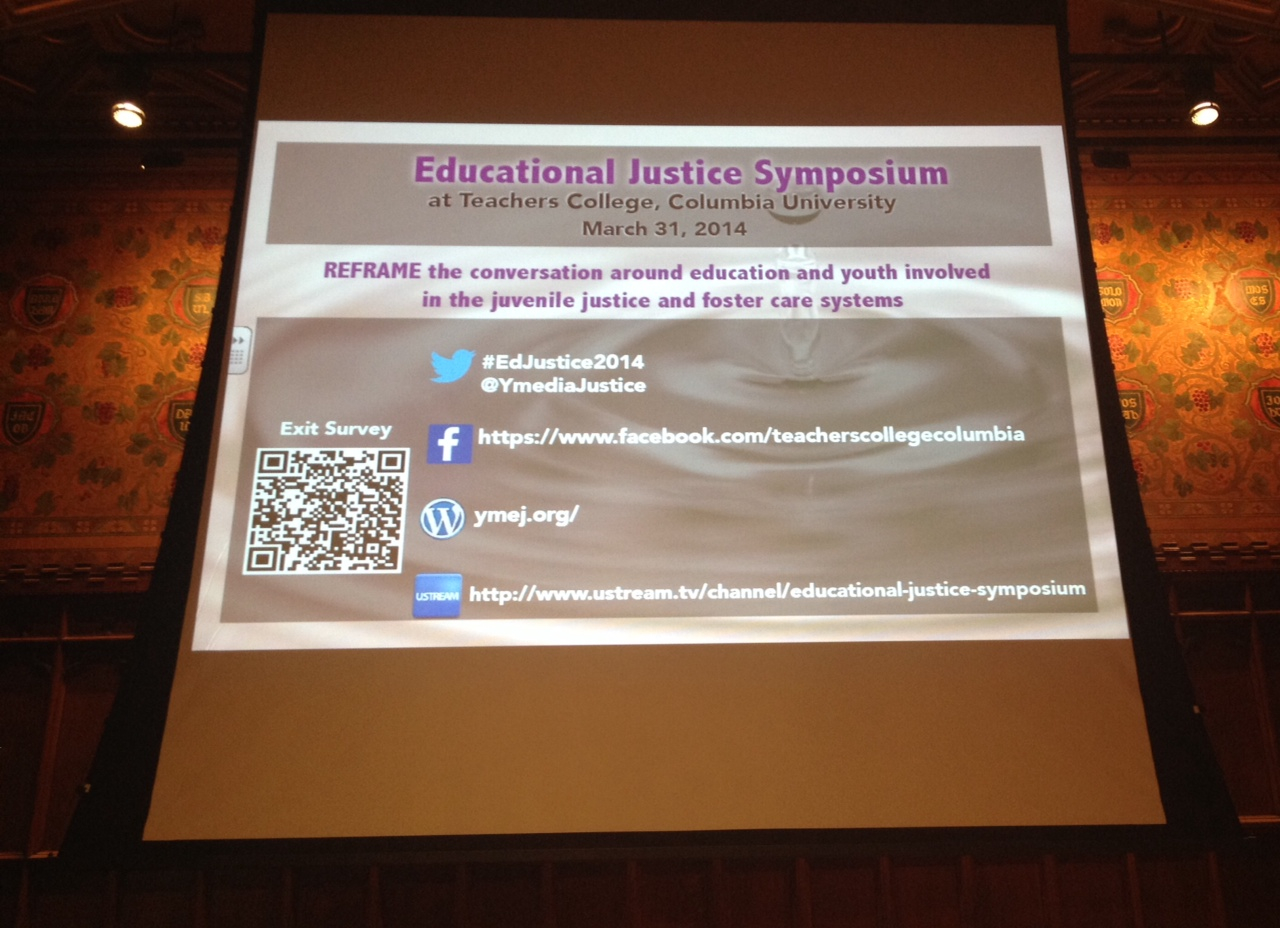
At the Educational Justice Symposium at Teachers College, Columbia University – March 31, 2014
It turned out that The Possibility Project’s latest show, “Uproute”, was happening last week so I took the opportunity to ride out to Brooklyn and see what the results looked like in person. The show had already started when I arrived, and one of the young staff members guided me professionally to a balcony seat overlooking the entire stage. For the next hour the stage was filled with dramatic encounters between the show’s teenage actors: conversations, arguments, scenes of bullying, family fights, child abuse, children running away, siblings in tears, and all of it coming from the experiences of the teenagers themselves.
The emotional power of the scenes easily compensated for any rough edges in acting ability. Lessons were clearly learned as each of the difficult situations moved towards resolution. The parents involved learned as many lessons as their children. The show culminated in an all-hands finale that was exuberant, playful, and moving. The sight of 50 teenage actors in the final song of the night could have been any high school musical but the power of their stories and the energy and emotion they used to share those stories set this performance apart.
After the show, still thinking about the heavy themes, I ended up in the tiny lobby packed with the excited actors and their proud parents, siblings, and friends. Youth were selling stylish merchandise to support the work of the organization, and everyone looked like they were enjoying what they were doing! The party spilled out onto the street as members of the cast gathered in front of the theater, still filled with the energy of the evening.
The evening was beautiful and powerful for me because I had been witness to something special, something that must have been transformative for those involved. The stories that were shared were vivid reminders of how much healing many young people need, and how it only happens when others are there to lean on and be supportive. Many of the speakers at the Ed Justice Symposium spoke of the critical importance of youth believing in themselves. Putting together a full-length musical in two months and presenting it to a full house is, in my mind, all about believing in yourself.
From Wait Time to Creative Time
In September 2013, the New York Probation Office published “Free Verse,” the first issue of a poetry journal that emerged from the thoughts of those waiting in the probation office at the Bronx Neighborhood Opportunity Network (NeON), a collaborative of community organizations, government agencies, local businesses, and community residents focused on connecting probation clients who live in the neighborhood with opportunities, resources and services.
As described in its opening pages,
Free Verse is a journal of poetry, prose, and song that promotes turning waiting time into creative time. Headquartered in the heart of the waiting room of the new South Bronx NeOn – where probation clients check-in with their probation officers – FreeVerse solicits new writing created while people wait.
As described in Gwen McClure’s article on the Juvenile Justice Exchange, “Free Verse” was the brainchild of Loni Tanner, Chief Change Officer for the NYC Department of Design and Construction and Executive Director of See ChangeNYC, as well as Dave Johnson, the Poet-in-Residence at South Bronx NeOn. Tanner informally named the program, in its existence since April 2013, “Not School”—an acknowledgment that learning for young people does not need to only be confined within classroom walls. Instead, learning opportunities exist in the most unexpected places. For Johnson, the program was a movement with a larger purpose than literacy and learning. As he explains,
This is a lot more than poetry; this is an opportunity to be welcomed back into society.
Thankfully, this innovative program has continued, recently releasing its Winter 2014 edition . Below are a few of my favorites from the collection:
I believe
in justice for all,
though no one opens a door.
in opportunity,
though the best ones don’t reach me.
in freedom, in equality,
but mostly I believe
in me.
TAISHA WILLIAMS
———————————————–
The Good Fight
One day I will not have to fight you,
the partner I was given in this lottery of life
that looked so promising until the drawing
as each number was pulled, it was clear, it was not a winner,
just another one to go with the other ones
in a pile of must forget yesterdays.
One day I will not have to fight the voices in my head
of people’s words placed wrongly in my spirit,
the words that should have rolled off my back,
but somehow, were deposited in my future.
One day I will not have to fight the urge to write about the sorrows
that have been my tomorrows, before tomorrow has even gotten here.
One day I will fight the good fight of keeping
the roaring laughter from my belly, fighting to make it out like a raging lion.
One day I will fight to open the cocoon, to let the butterflies I protected, go free.
You’ll never know the pressure I endured, to be cut, into the diamond you see.
MARLITA DALTON
————————————————————-
Today,
I’m a life.
I’m not just passing by.
CRISTY BAPTISTE
Breaking Barriers Through Storytelling in an ATDP
Earlier in the academic year, I was asked to ponder the following question as part of my coursework for the Youth Media and Educational Justice seminar:
What do educators need to consider when court-involved youth – reentry, on probation, in foster care — are in their classrooms and schools (and programs)?
In response, I offered the following:
In thinking about this question, I was reminded of Virginia Shabatay’s (1991) piece “The Stranger’s Story” Who Calls and Who Answers?” in which she poignantly asks, “How do those of us in the helping professions discover the strangers among us? How can we develop sensitive caring relationships with those who feel set apart?” (p. 137). In her eloquent treatise, she posits, “We bring certain attitudes to those whom we don’t know: suspicion, mistrust, caution, and bias, or trust, openness, and welcome” (p. 137). Accordingly, she urges readers to use stories as ways to discover what strangers have to teach. She explains, “Stories allow us to break through barriers and to share in another’s experience; they warm us. Like a rap on the window, they call us to attention” (p. 137). Shabatay’s insights resonate with me as ways in which entering into dialogue and exchanging stories can combat strangehood in our classrooms, schools, programs, and research.
Since the time of this assignment, I have had the opportunity to begin volunteering work every Thursday as a mentor at an alternative to detention site in New York City. During each visit, I have the privilege of witnessing and participating in the embodiment of Shabatay’s words— the sharing of stories that allow space for possible connection between participants, staff, and volunteers. Around the small conference table, youth who because of their current situation often feel “set apart,” are approached not with “suspicion, mistrust, caution, or bias” but with “trust, openness, and welcome.” Through dialogue and narrative, a community is formed that is mindful of and active in recognizing and then disabling the human tendency to judge, to categorize, and to stereotype. Through human exchange, we no longer are strangers. We are companions. It truly is a remarkable place and each visit pushes me to consider ways in which more spaces and places can be created for court-involved youth and others to “break through the barriers and to share in another’s experience.”
Love Letter III: Dear J.
The third piece in my series of love letters dedicated to the experiences and people that touch me throughout the course of this semester. The latest, I letter to my student who sustained a gunshot in the stomach two weeks ago, and how I’ve been processing it all since.
* * * * *
Dear J.,
I hope this letter finds you well.
Well. Such a bland, insignificant word that often claims nothing more than mediocre ties to caring.
How are you feeling?
Feeling. We ask as if physical and mental emotions can be tersely conflated into a one word response like “good.”
We need to do better.
My heart
is heavy.
Heavy—of great weight; difficult to lift or move.
Heavy, a tangible mass, like what we feel when lifting our grocery bags or a small child up from the ground and into our arms
allowing for the contents to settle,
finding their places on the shelves of our hips, in the nooks of our arms and caverns of our eyes.
Bulbous tears have continued to drop from these eyes for the last seven days,
every time I end the second sentence of this story with, “…shot”.
I’ve told eight people about what happened to you.
Eight people have given me their ears, their eyes, their hearts, their hugs, their attention.
They have listened as I’ve unfolded the details of what went down last Thursday night:
You’d been shot in the belly.
It was gang-related.
You were in the ICU for the entire weekend, under a pseudonym so no one could find you, but you’re home now, resting.
You lost three quarters of the blood in your body.
And when the cops, standing on the steps of their precinct, saw you stumble forward towards the ground they rushed over and began interrogating you—asking you whether you were high or drunk.
It wasn’t until they pulled you up to your feet, and you screamed out in pain, that they realized you had a bullet in your belly…
I can’t stop thinking about you—there is a stream of still and moving images playing on a loop in my mind, accompanied by an internal monologue of questions,
wondering about the moments building to crescendo—
who spoke the last words, what were they? Does it matter? Are you scared?
But this mentally isolated indie film streaming on my brain waves and plucking at my heartstrings is fabricated, imagined, “flattened by my seeing.”[1]
I have to examine how the “physical structures of our seeing and the patterns of thought these mechanisms create, among them spectating, consuming, and flattening, mis-take the world”[2]
You see, J., I’ve been retraumatizing myself over the course of this week. I continue thinking about this event, imagining not what it must be like to get shot; not even to self-deprecatingly wonder “what I could have done to save you.” No. I keep replaying this moment as my way of connecting with you and to the human emotions associated with trauma.
Because this notion of “gang violence” has become a soapy word in our American vernacular and on the 6 o’clock news.
While we might listen to these reports for an affirmation that a shooting took place somewhere deep in the South Bronx, or in Brownsville, or in the Heights—you know, a place where we “know these things take place” because the kids there are violent, illiterate, dangerous
—we don’t hear these stories, who these young people are,
nor do we pause to think about the institutional forces, the dominant narratives, and the normalized practices that are at play, convincing us that this is simply endemic of certain populations. It’s their problem, not ours.
We must ask ourselves, “Does the multiplicity of seeing tragedy compound the horror
or do the repetitive views overwhelm and desensitize?”[3]
This is the ‘closest’ I’ve been to knowing someone who’s been shot,
and I’m overwhelmingly aware of what a privilege it is for me to say this; for this to be my reality.
It’s not a feeling of guilt or naiveté; it’s the weight of the awareness, of the borders and worlds that I am straddling right now. I am working to reconcile my simultaneous locations in them all, and understanding that reconciliation is really neither feasible nor covetable.
This is difficult knowledge[4] we’re dealing with.
That’s not an excuse or prescription, but rather a description; a naming of place, and space and time that deserves attention and love. Or else the knowledge will become dangerous and polarizing (more so than perhaps it already is).
All this said, I want you to know, J, that I see you.
Though I may sometimes be looking at you…sometimes looking after you.
Please know that more than anything, I’m striving to see with you.[5]
Recover strong, heal well, and be safe.
Emily
P.S.
Even before you got hurt, I looked for you in the hallway every Monday and Thursday, when you weren’t coming to school on a regular basis.
I stood against the wall, perching my heels at a 45-degree angle against the plaster and linoleum, scanning faces for yours
I walked up and down the hall once or twice, bobbing and weaving past individuals, then groups of friends, squirming through the hallways, occupying as much room as they can (and they should—they’ve been locked up in classrooms since 8am).
For the past month, I’ve come up empty handed every time, yet still kept looking.
And then today, I hadn’t started my search for you yet, I was going to get settled in my classroom first and there you were.
You’re so much smaller than you were two months ago.
I try to make eye contact with you three times from across the hall, I try to wave, unsure if you see me.
I’m fighting off the guidance counselor who is handing me a survey the students have to fill out—that asks questions that we require them to place themselves in boxes, to represent their answers with “x”s; to place themselves back in the boxes that I am so committed to working with them to break out of.
I’m fighting off students streaming down the hallway, backpacks swinging, sneakers squeaking, laughter so loud, but it feels so far away.
I walk over and I know that you’ve seen me at this point. You’re clumsily putting your jacket on, pretending to be busy, being a 17-year-old.
You look up and make eye contact with me—I timidly unroll my arms to a curved wingspan, so incredibly unsure if this is ok. If I can come into contact with you. To hug you.
You mirror my limbs, a small smile on your face, and you hug me.
It lasts only a brief moment before we pull back.
I ask you how you are.
Good.
I ask you how you’re feeling.
Fine.
And then I’ve go no other questions, not the slightest idea of what to say to you next…
I am not qualified for this shit…
…but it’s alright.
Since the last love letter I’ve realized that my lack of qualifications actually makes me one of the most qualified people to be having these experiences. To have these young people in my life. They are providing me with moments and glimmers of, and access to realities other than mine, which will slowly equip me with the qualifications to know that this “shit” can never truly be mastered, but that it is in the experiences I gain expertise in the willingness of unknowing.[6]
Post-script, written in the afternoon following the morning’s love letter.
Your Story and Mine
As part of a good practice we often keep in mind “who” we are, what is our story, and how it influences our perception on the research field and the practice. This has been a long debate: should our personal story inform our practice? Maybe in some contexts the answer is a clear yes. Nonetheless, in my native France, mixing the personal story and the professional practice is negatively perceived. Being a true professional is to be able to deny our personal story.
Being raised and mostly educated in France, I am now studying in the USA; sometimes, it feels like walking on a wire. Which part of myself, of my personal story, could inform my practice? How can I question my personal stories to better reflect my posture, my reaction and my subjectivities in my professional practice? How have my personal narratives created potential stereotypes and misconceptions about the field I study?
I grew up as a teenager in the suburbs of Paris, witnessing the unfairness of the system towards populations who do not conform to the model of a standard citizen. This issue is, of course, not restricted to France. Whether you are White or not, Black or North-African, whether you are wealthy or not, whether you are labeled disabled or not, whether you could afford private school or not; the intersection of these elements considerably influences your educational experience and eventually has dramatic consequences on your future.
During my childhood and teenage-hood, I have been a witness and an activist. Today, I am the lucky one, part of a thoughtful cohort at Teachers College; we do not have to worry much about our future, so we gather our efforts for the future of others, for a better society and for social justice.
Therefore, I would like today to engage my peers, my professors, the audience, to further the reflection that might sound futile, but that is crucial to our practice: How can we understand the context we are working in? Where does our personal story fit in our research and practice? Lastly, how can I ensure that the words I am typing are not fulfilling new stereotypes?
After Prison, A New Set of Doors
When I was in junior high school, New York City public transit fares switched from tokens to MetroCards. The Metropolitan Transit Authority rolled out ads on subways and buses describing how to swipe these strange new plastic rectangles, and our homeroom teachers explained the change from the old paper student bus and/or subway passes to the new student MetroCards that would work on either form of transportation. On the plus side, we would now be able to swipe ourselves through the turnstiles instead of trying to catch the attention of a distracted (or absent) token booth attendant in order to flash our paper passes and get buzzed in while our train rolled on without us. In addition, the plastic MetroCard survived an occasional trip through the washing machine much better than the old paper pass, which I would regularly have to present in a soggy mess to the school office in the hopes that they would have an extra one to last me through the month. On the minus side, the new MetroCards were limited to three swipes per school day, which meant we had to go beg at the school office to cover weekend extracurriculars or other trips.
Recently, while attending a meeting, I was reminded of this experience from nearly two decades ago, particularly that vivid feeling of dismay as I pulled my jeans from the dryer and felt that familiar lump in the back pocket. While discussing transition services, a woman who had previously been incarcerated mentioned that many people she knew had gone into prison while the city used tokens, and come out to MetroCards, which they had to newly learn how to use. Although that shift may seem small in the grand scheme of things, it struck me as an example of how completely time in jail or prison disrupts every single aspect of a person’s life. For a New Yorker, reminiscing about the old days of tokens and paper student transit passes is the same sort of nostalgia-inducing experience as reminiscing about when we had to go to the library to get books for school projects before the internet, plan get-togethers at least a day in advance before cell-phones, and, of course, walk twenty miles through the snow, uphill both ways, to even get to the local subway stop to take us to school. How strange it must be to go away from one world, only to reappear years later into an entirely different one without any sort of warning.
Back when I was a teacher, many of my students got arrested. One bright, kind, funny boy disappeared one winter, and arrived back in class months later, near the end of the year, just days before the science fair which I was organizing. Of course, he had no project; his partner had simply done it without him. I wondered how this child had benefited from missing an entire semester of school, from simply appearing at the end with an incomplete posterboard.
The term “reentry” implies that a person can somehow enter the same metaphorical room again, and go back to where they were before getting arrested. But the reality is that a person who has been incarcerated is newly entering a world that has moved on without him or her. That person is traveling into the future, to where the subway no longer takes tokens and the science fair is already happening.
Rehabilitation vs. Criminalization: The Need to Rethink Juvenile Justice Programs in New York
An editorial from this week’s New York Times, “When Children Become Criminals,” engages the question: at what age and under what circumstances should a minor be tried as an adult? This is in response to Andrew Cuomo, governor of New York, recently announcing that he would be putting together a commission to develop a plan (recommended changes in laws and procedures) for raising the age for adult criminal prosecution by the end of 2014. Nearly 40,000 adolescents are sent through the New York criminal courts every year, most charged with nonviolent crimes like shoplifting, jumping the turnstile in subway, or possession of marijuana. As is well known, Black and Latino young people, especially young men, are highly overrepresented in New York’s court-involved youth population. One of the major takeaways from the article is the mention of the effects of putting children as young as 16-years-old through the adult court system:
Federally financed studies have shown that minors prosecuted as adults commit more violent crimes later on and are more likely to become career criminals than those sent though juvenile courts, where they receive counseling and family support. Beyond that, neurological science has shown that adolescents are less able to assess risks and make the kinds of mature decisions that would keep them out of trouble.
In 2007, Connecticut raised the age of criminal prosecution from 16 to 18, a law which took full effect in 2012. The state has also adopted new strategies for court-involved young people based on “rehabilitation, not lockups,” working to reduce arrests and save the state money. The Connecticut Legislature created a council of experts from law enforcement, mental health, and other fields to coordinate policy changes. The interdisciplinary collaboration is significant. Connecticut has ceased trying cases involving “nonthreatening adolescent misbehaviors,” like possession of tobacco. Most importantly, the state invested in counseling and intervention programs that “allow young people to make amends for minor misdeeds without going to court.”
I was surprised to learn that New York is one of only two states (North Carolina is the other one) in which 16-year-olds are still automatically tried as adults. The New York law came into effect with the state’s creation of the juvenile justice system under the Family Court Act in 1962. Unable to agree on an age at which offenders should be declared adults, lawmakers temporarily set it at 16, but “…as often happens with public policy, inertia set in and ‘temporary’ became permanent.” More than 250,000 youth under the age of 18 are tried, sentenced, or incarcerated as adults each year. And in New York, almost 90% of boys released from juvenile incarceration are arrested again.
As mentioned above, there have been growing conversations about the repercussions of sending young people through the criminal court system as opposed to providing them with rehabilitation services that might help to address underlying emotional, physical, mental, sociocultural, and environmental factors influencing behaviors. When young people are labeled as criminals or delinquents and tried as adults, their education is disturbed, their psyche is affected, and their re-entry into school and life can be extremely difficult and damaging, especially as they are going through crucial developmental stages of pre-adolescence and adolescence.
In addition, critics argue that many detention centers wrongly focus on punishment rather than rehabilitation for young people. In a recent article on activists’ call for juvenile justice system reforms, AlJazeera America, highlights a new campaign working to change the procedures that the justice system uses with children and adolescents. It’s called Raise the Age:
Raise the Age New York is a public awareness campaign that includes national and local advocates, youth, parents, law enforcement and legal representative groups, faith leaders, and unions that have come together to increase public awareness of the need to implement a comprehensive approach to raise the age of criminal responsibility in NYS so that the legal process responds to all children as children and services and placement options better meet the rehabilitative needs of all children and youth.
I encourage you to check out the Raise the Age website and learn more about the reasons for the campaign and the holistic impact that raising the age could potentially have on the state’s juvenile justice system.
Reading the NYT article and learning about the Raise the Age campaign served as reminders about how the juvenile justice system needs a lot of work, but it is also highlights how imperative it is that we–society, educators, activists, parents, mentors, allies–work hard to challenge dominant narratives about “juvenile delinquents.” It is easy, especially in a sensational-news-saturated world to make snap judgements about young people incarcerated at a young age (who continue to lead lives of crime and punishment). Instead of just accepting the idea that young criminals look or act a certain way, lead certain lifestyles, or have the ability to make different choices but choose a life of crime instead, I encourage us all to take a step back and think about the programs and procedures that are set up to address and hopefully prevent such lifestyles and trajectories. Let’s think about productive and meaningful ways to support young men, in particular, labeled as failures and delinquents before they even grow facial hair.
How can we raise awareness? What kinds of conversations can we have? What new strategies and laws must be put in place in order for legitimate change to occur? Ask yourself these questions, pose them to others, and find more answers at Raise the Age.
Upcoming Event on US Prison System
Hi Everyone,
If you are located in the NYC metro area, come check out this awesome event on Thursday!
Join the NYC Student Collective to End Mass Incarceration for a conversation about the United States prison system. Our discussion will be structured around a mapping exercise used in the conflict resolution field. We will share knowledge about what factors perpetuate or interrupt mass incarceration, in order to try and strategize how the collective can can best engage in anti-prison work.
 Youth, Media, and Educational Justice